StorageTreasures Auction App
- 3.6
- Rating
- 100.00K
- Installs
- Free
- Price

 Analysis by App-foxy
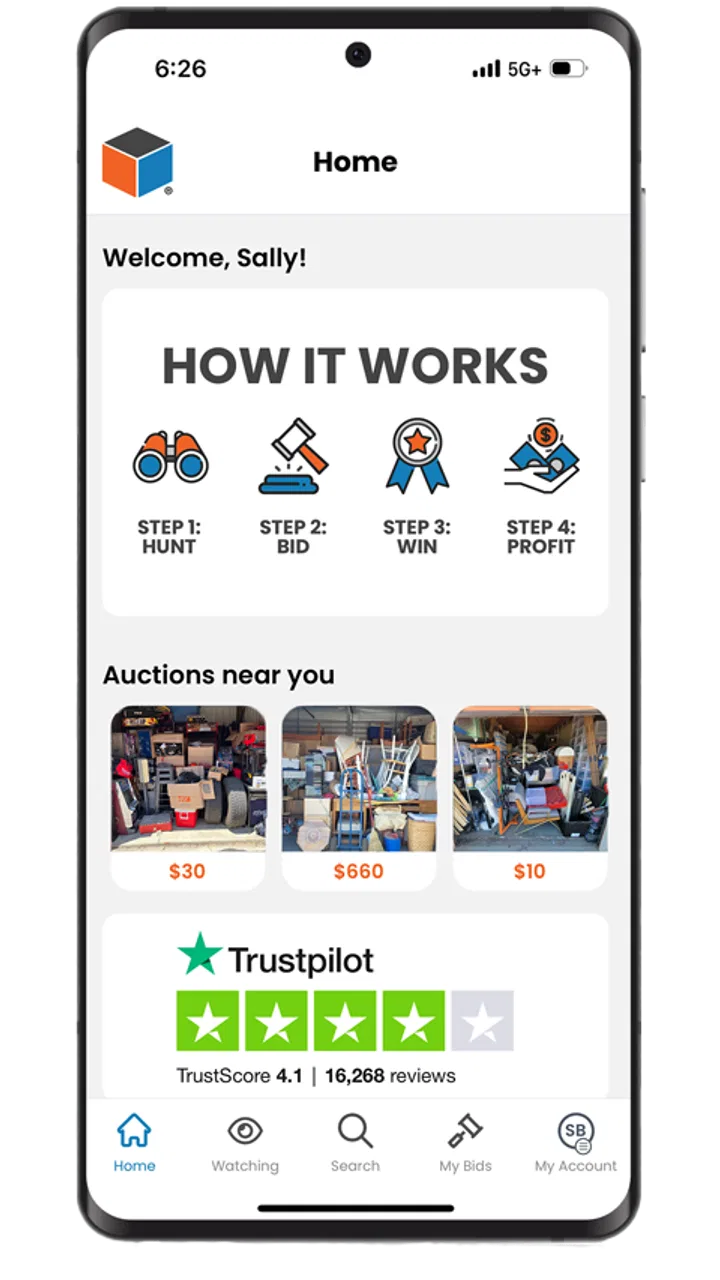
StorageTreasures Auction App is built around one clear idea: finding and bidding on nearby storage-unit auctions from a phone. I see it as a practical shopping tool for people who enjoy the uncertainty of buying abandoned or unclaimed storage contents, rather than as a normal marketplace for carefully described products. The appeal is the local angle. Instead of browsing random listings across a large shopping platform, I can use the app to focus my attention on auctions connected to places near me.
That focus changes the whole experience. A storage auction is not simply a cheaper way to buy a known item. It is a decision made with incomplete information, where photographs, descriptions, location and timing matter as much as the bid itself. The app makes the discovery and bidding side more convenient, but it does not remove the judgment required before committing money. The most important feature is not the bid button; it is the ability to turn a vague local search into a shortlist of auctions worth investigating.
Finding local auctions instead of browsing a general shopping catalog
OpenTech Alliance developed this free shopping app for Android users who want to discover local online storage auctions. Its store summary describes the central use accurately, but in everyday use the value comes from combining location awareness with auction browsing. I can look through available opportunities from my phone, compare the listings that catch my attention and decide which ones deserve a closer look before spending time or money.
You May Also Like

 AccuWeather: Weather Radar
AccuWeather Review: A Quick, Clear Forecast for Everyday Decisions
For everyday plans, the best forecast is the one you can understand quickly. AccuWeather makes rain timing, radar, and local conditions easy to act on, with a few trade-offs.

 Hill Climb Racing
Why Hill Climb Racing Still Turns Crashes Into One More Run
A tiny car, a bumpy hill and one more upgrade: Hill Climb Racing keeps resurfacing because its simple chaos makes every near-miss feel personal.

 AliExpress - Shopping App
AliExpress Makes Global Shopping Feel Personal, but Shoppers Bear the Risk
AliExpress turns a global marketplace into a pocket-sized discovery engine. Its reach is useful, its shopping loop compelling, and its trade-offs easy to miss.

 Lords Mobile: Kingdom Wars
Lords Mobile Is a Kingdom-Building Routine, Not a Quick Match
A case-by-case verdict on the building, battles, device demands, and social commitments that make Lords Mobile rewarding for some players and exhausting for others.

 PDF Scanner app - TapScanner
TapScanner Makes Paperwork Easier to Capture, Check, and Share
TapScanner makes scanning with a phone feel less like a rescue operation and more like a dependable step in getting work done. Its capture tools are useful, though not flawless.

 Block Blast!
 Shows How Much a Puzzle Game Can Leave Out
A quiet grid game shows why puzzle players increasingly value instant clarity, repeatable skill and low-pressure play—and where the genre still needs to catch up.
More From Our News Desk
View All News


This is different from using a conventional shopping app. On a typical marketplace, I search for a particular product, inspect a known item and compare sellers. Here, I am evaluating a whole storage unit or auction listing, often with only visual clues and a short description. The app therefore suits a more exploratory kind of shopping. It is closer to digital treasure hunting than to ordering a replacement charger or choosing a precisely specified piece of furniture.
The local focus also matters because winning an auction usually creates a practical responsibility: the contents are connected to a physical location, and the buyer needs to think about travel, transport, sorting and removal. Even when I am only browsing, I find it useful to treat distance as part of the price. A low winning bid can become far less attractive if the unit requires a long drive, a vehicle I do not have or several hours of work to clear.
StorageTreasures Auction App has a 3.6 average from around 619 ratings, with over 100 thousand installs. Those figures suggest a real audience, but also a mixed experience rather than universal approval. I would not interpret the rating as a reason to avoid it. Instead, it tells me to approach the app for its specific purpose and to expect the quality of an auction experience to depend partly on the listings, the storage facility and my own preparation.
What I actually evaluate before opening an auction
When I browse a storage listing, I try not to let one visible object decide the bid for me. A recognizable item in a photograph may be damaged, incomplete or surrounded by things that are difficult to sell. I look at the entire unit and ask whether the contents appear manageable, whether there is enough variety to justify the risk and whether the likely cleanup is realistic for my schedule.
This is where the app is more useful than a simple classified-ad search. The purpose is not just to show me individual goods; it gives me a place to consider an auction as one package. That encourages a different mental habit. I am not asking, “Can I resell this one chair?” I am asking, “Would I be comfortable taking responsibility for everything visible here?”
A useful approach is to create a personal ceiling before bidding. I estimate what I might reasonably recover from the contents, then subtract transport, cleaning supplies, disposal and the value of my time. I keep the remaining amount as a maximum rather than treating it as a target. This prevents the familiar auction mistake of increasing a bid simply because I have already spent time studying the listing.
Another practical tip is to separate curiosity from action. The app makes it easy to browse interesting units from a sofa, but a listing that looks exciting on a small screen may be much less appealing after considering the pickup effort. I would save or revisit only those auctions that pass three tests: the location is workable, the contents look within my ability to handle and the maximum bid still leaves room for an unpleasant surprise.
How the bidding experience changes the usual shopping routine
The app’s role is strongest before and during the bidding decision. Instead of waiting until I am near a desktop computer, I can check local opportunities while planning my week or while comparing several possible purchases. That mobile access is valuable for people who regularly monitor auctions, because timing and attention are part of the process.
Still, I would not confuse convenience with certainty. An online auction can make bidding feel quick, while the consequences remain physical and time-consuming. A winning bid is not the same as receiving a parcel at home. I need to think ahead about how I will inspect, move, store, donate, recycle or dispose of what I acquire. The app helps me participate in the auction, but my preparation determines whether the result feels like a bargain or a burden.
For a first-time user, I recommend spending several sessions observing listings before bidding. Notice how photos are framed, how much information is normally available and how quickly auctions attract attention. This creates a personal reference point without risking money immediately. It also makes it easier to identify listings that are genuinely interesting rather than simply unfamiliar.
I would also keep notes outside the app for auctions I am considering. A simple record of the location, closing time, maximum bid and expected transport plan is enough. The reason is not that the app is incapable of showing auction information; it is that writing down my own limit makes the decision more deliberate. It also reduces the chance of confusing two similar-looking units when browsing several opportunities.
A realistic weekend use case
Imagine I have a free Saturday, access to a suitable vehicle and some room in a garage. I open the app during the week and look for nearby storage auctions. One listing shows boxes, shelving and what appears to be household furniture. Rather than assuming the visible furniture will cover the cost, I examine the whole image set and consider the amount of sorting involved. I check the location and decide whether the drive fits comfortably into my weekend.
I then set a maximum that leaves room for fuel, cleaning and disposal. If bidding passes that point, I walk away. If I win within the limit, I treat the following steps as part of the purchase: arranging transport, arriving prepared, separating potentially useful goods from rubbish and making sure I can clear the space efficiently. In this scenario, the app is genuinely helpful because it brought a local opportunity to my attention and let me act without being tied to a computer.
The same scenario also shows the app’s boundary. It cannot make an uncertain unit predictable. The photographs may reveal useful clues, but they do not turn a mixed storage space into a guaranteed inventory. Someone who enjoys evaluating risk and doing hands-on sorting may find that uncertainty exciting. Someone who wants a known product, a clear return path and delivery to the front door will probably prefer a standard shopping service.
The tradeoff between discovery and information
The strongest tradeoff is simple: the app makes it easier to discover auctions, but storage auctions are inherently less predictable than ordinary purchases. I may find opportunities I would never encounter through a normal retail search, yet I also have to accept that the available information may not answer every question I have before bidding.
That makes discipline more important than enthusiasm. I avoid valuing hidden contents as if they were already confirmed. I treat recognizable brands, sealed boxes or apparently valuable objects as possibilities, not guarantees. I also remember that a unit can contain a mixture of useful goods and items that cost money to remove. The app supports the search, but it cannot replace an honest estimate of labor and risk.
There is also a difference between being interested in resale and simply wanting inexpensive household goods. If I need a specific desk, appliance or tool, a local classified listing may be better because I can inspect that individual item and negotiate directly. If I want the widest selection of clearly described products, a mainstream marketplace is more efficient. StorageTreasures makes more sense when I am comfortable buying a collection of unknown contents for the chance of finding several worthwhile items.
The age classification is Mature 17+, so I would not treat it as a casual app for children. That is reasonable for an auction service involving financial decisions and real-world transactions. I would also encourage any new user, regardless of age, to involve someone experienced in transport or resale before bidding on a large unit. The practical risks are not limited to the amount offered; clearing and handling the contents can be the harder part.
Another limitation is that the app’s usefulness depends on whether there are worthwhile local auctions for me to browse. A person in an area with few suitable listings may open it often and find little that fits. In that situation, a broader marketplace or local auction site could provide more consistent activity. The local emphasis is a strength when the surrounding area is active, but it naturally narrows the pool compared with nationwide shopping platforms.
Who will get the most from this app?
I think the best audience is made up of curious bargain hunters, resellers, collectors and people who already understand that a storage-unit purchase is a project. These users can look beyond one attractive object, calculate a sensible limit and handle the physical work after winning. For them, mobile access removes friction from the most useful part of the process: finding opportunities and keeping track of the ones that fit.
It can also suit someone who wants to test the storage-auction world without immediately investing in specialist equipment. Browsing from a phone is an approachable first step. I can learn what kinds of units appear nearby, see whether the format interests me and develop a bidding routine before making the activity a regular hobby.
I would be more cautious recommending it to someone who dislikes uncertainty, has no way to transport bulky items or expects every purchase to be returnable. It is also a poor match for a person who tends to bid emotionally. The app can put tempting possibilities in front of me, but it cannot prevent overbidding. If I know that competition makes me ignore my budget, watching auctions without participating may be wiser than placing a first bid.
People who resell should be especially careful with optimistic calculations. A unit may contain items that are difficult to photograph, test, clean or ship. I would prioritize goods I can realistically move through my existing sales channels rather than assuming every object has resale value. The best result may sometimes be a modest collection of usable items, not a dramatic profit.
Everyday usability and what to expect from the app
StorageTreasures Auction App is free, which makes experimentation less intimidating. I can install it without paying an entry fee for the app itself and decide whether local storage auctions fit my interests. Its current version is 1.22.0 and it supports Android 7.0 or later, so compatibility should cover many older Android phones as well as newer devices.
I would still keep expectations grounded. A free app can remove the cost of browsing, but it does not remove the money involved in bidding or the work connected with a winning auction. I see the free price as an invitation to investigate, not as evidence that the activity itself is inexpensive. Before using it seriously, I would prepare a budget that includes the parts the screen cannot show: transport, equipment, storage space and time.
The app is most valuable when I use it as a filter rather than as a source of impulse. I browse local listings, reject anything that creates an impractical pickup plan and study the remaining options with a fixed limit. That workflow turns the phone into a planning tool. Without the filtering step, the same convenience can encourage me to watch too many auctions and bid on one simply because it is available.
I also like the idea of using it alongside, rather than instead of, ordinary local resources. A general marketplace can help me estimate what similar visible items might sell for. A map can help me judge travel time. A calculator can keep the maximum bid honest. The app is the auction-specific part of that process; the strongest decisions come from combining it with practical preparation.
My recommendation after using it as a local auction tool
StorageTreasures Auction App succeeds when I treat it as a focused way to discover and bid on nearby storage auctions, not as a guaranteed bargain machine. Its central capability is useful because it brings a specialized kind of local shopping to a mobile screen. I can explore opportunities at a convenient time, compare them with my schedule and decide whether the uncertainty is worth accepting.
My recommendation is positive for the right person: someone who enjoys research, can set a hard spending limit and is prepared to deal with the entire contents of a unit. I would skip it if I need predictable products, delivery or a simple one-item purchase. In those cases, a conventional retailer, classified listing or general marketplace will be less demanding.
The best way to start is to browse without bidding, choose only auctions that fit a realistic pickup plan and calculate the full cost before getting emotionally attached to a listing. Used that way, the app’s local discovery focus becomes genuinely practical. It does not eliminate the risks of storage auctions, but it gives interested buyers a convenient place to find them and make more informed decisions.
FAQs for StorageTreasures Auction App
01What is the StorageTreasures Auction App?
StorageTreasures Auction App is a mobile platform for browsing and participating in online storage-unit auctions. It allows users to view available listings, inspect photos and descriptions, check auction details, and place bids from a phone or tablet. The app is designed for people interested in purchasing abandoned or lien-sale storage units, although availability and auction rules can vary by location.
02How do I participate in an auction through the app?
To participate, you generally need to create an account, provide the requested contact information, and complete any required verification steps before bidding. After finding an auction, review the unit’s photos, location, closing time, payment instructions, and pickup conditions. If you decide to bid, enter your maximum amount carefully and monitor the listing, since another bidder may raise the price before the auction closes.
03Are there additional fees when buying a storage unit?
Yes, the winning bid may not be the total amount you ultimately pay. Depending on the auction and local requirements, buyers may encounter buyer premiums, sales tax, cleaning deposits, late-payment charges, or other service fees. Transportation, disposal, and labor costs are also your responsibility. Always read the complete auction terms and payment information before placing a bid.
04What happens after I win a storage-unit auction?
After winning, you typically receive instructions explaining how and when to pay, where to collect the unit, and how long you have to remove its contents. Pickup deadlines are important because facilities may charge fees or cancel the sale if you do not arrive on time. Bring suitable transportation, tools, and help, and follow the facility’s identification and access requirements.
05Is StorageTreasures Auction App safe and suitable for beginners?
The app can be useful for beginners, but online storage auctions involve financial risk and uncertain inventory. Photos may not show every item clearly, and the contents of a unit are usually sold as-is, with no guarantee of value or condition. Start with a strict budget, research local rules, understand the refund policy, and never assume that a visually appealing unit will produce a profit.
Pros
- Browse auctions and place bids from your mobile device.
- Search listings by category
- location
- and auction status.
- Auction details include photos
- descriptions
- and bidding information.
- Useful for discovering surplus
- returned
- and liquidated merchandise.
- Account access helps track bids and manage auction activity.
Cons
- Some listings may have limited photos or incomplete item descriptions.
- Pickup locations can be inconvenient depending on the auction.
- Winning bids may be subject to buyer premiums or additional fees.
- Bidding competition can make final prices higher than expected.
- App performance and listing updates may vary by device or region.

StorageTreasures Auction App
Gallery